


Every week, thousands of players search for free cheats. The logic makes sense on the surface — why spend $20 a month on something you can apparently get for nothing?
We’ve been building and maintaining game enhancement software since 2015. In that time, we’ve watched players make this calculation thousands of times. The ones who go free almost always come back — after a ban, after a stolen account, or after finding malware on their PC. Here’s what actually happens on the other side of that decision.
The Real Cost of a “Free” Cheat
Let’s start with what free cheats actually are, because most players have completely the wrong picture.
Free cheats don’t have a development team pushing updates. They don’t have engineers reverse-engineering Ricochet or BattlEye after every patch. What they have is someone who wrote code once — often copied from public sources — and dropped it on a Discord server or forum. That code has a signature. Anti-cheat systems like Easy Anti-Cheat, BattlEye, and Ricochet maintain massive databases of known cheat signatures. The moment your loader injects a known signature into game memory, you’re flagged.
The fastest ban we’ve documented from a free cheat was under an hour. The longest lasted 36 hours. That’s not a range you can build a gaming session around.
But the ban isn’t even the worst part.
⚠️ Quick stat:
In early 2025, a popular free Rust cheat was downloaded over 40,000 times. Within 3 days, 90% of users were permanently banned — many with hardware bans that locked their entire PC out of the game.
The Malware Problem Nobody Talks About Enough
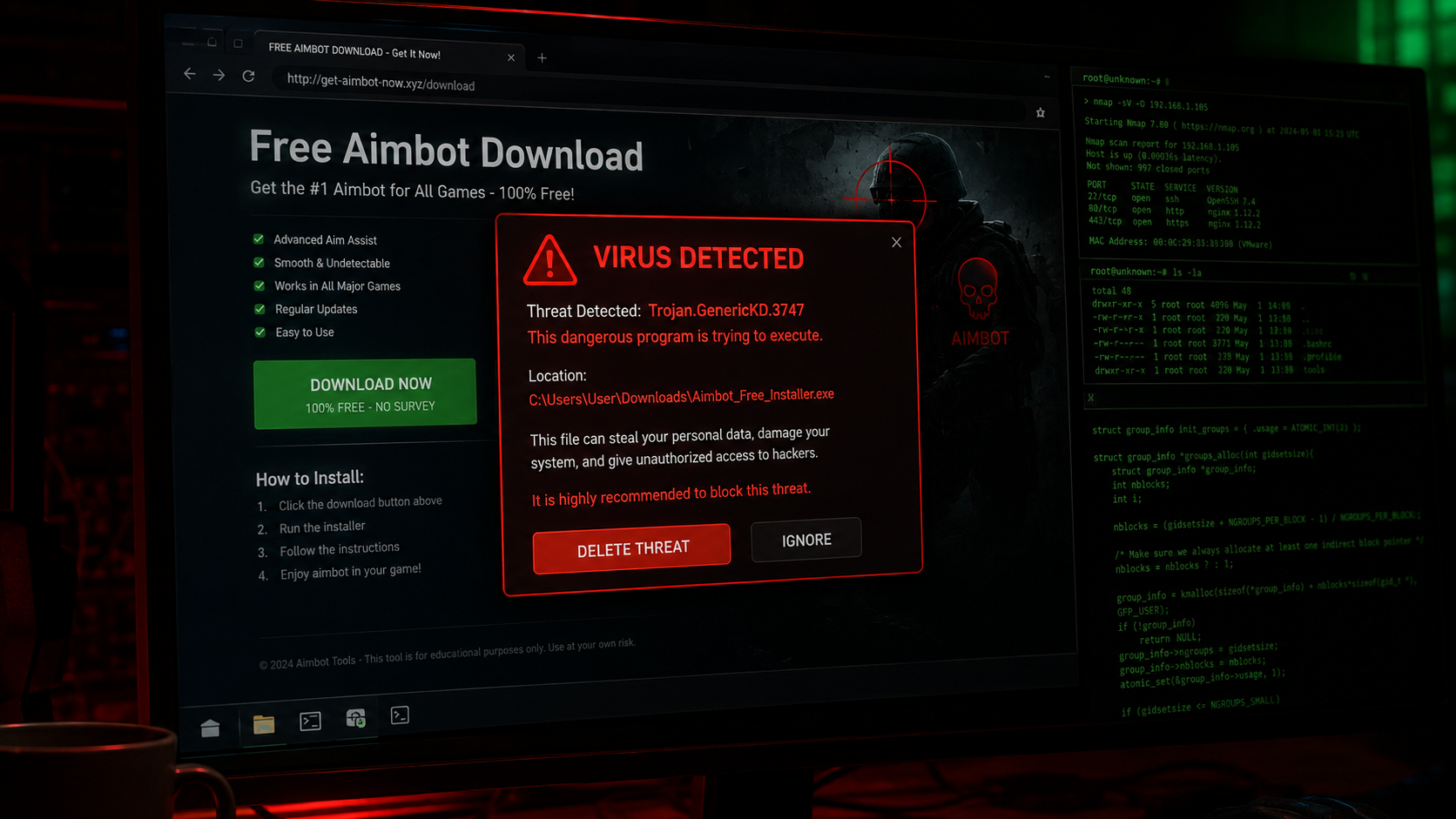
In late 2025, cybersecurity researchers documented a large-scale campaign where criminals distributed infostealer malware — specifically Lumma Stealer — disguised as free Fortnite and Roblox cheats. The files were distributed through YouTube videos, Discord servers, and GitHub repositories.
Here’s what made it effective: the cheat actually worked. Players downloaded it, launched it, got some features. Meanwhile, in the background, the software was harvesting saved browser passwords, banking cookies, Discord tokens, and Steam credentials — and sending them to a remote server.
These aren’t fringe cases. Organized criminal groups called “Traffer Teams” recruit affiliates specifically to spread these files. The affiliates get paid per install. They don’t care whether you get banned. They care that you ran the executable.
When you’re asked to disable your antivirus to run a cheat loader — and you will be, with every free cheat — you’re being asked to remove the last layer of protection between your PC and whatever that executable actually does.
A Steam account with 3,000 hours and a $400 inventory isn’t worth risking for a free aimbot that’ll get you banned before your second match.
What Paid Cheats Actually Pay For
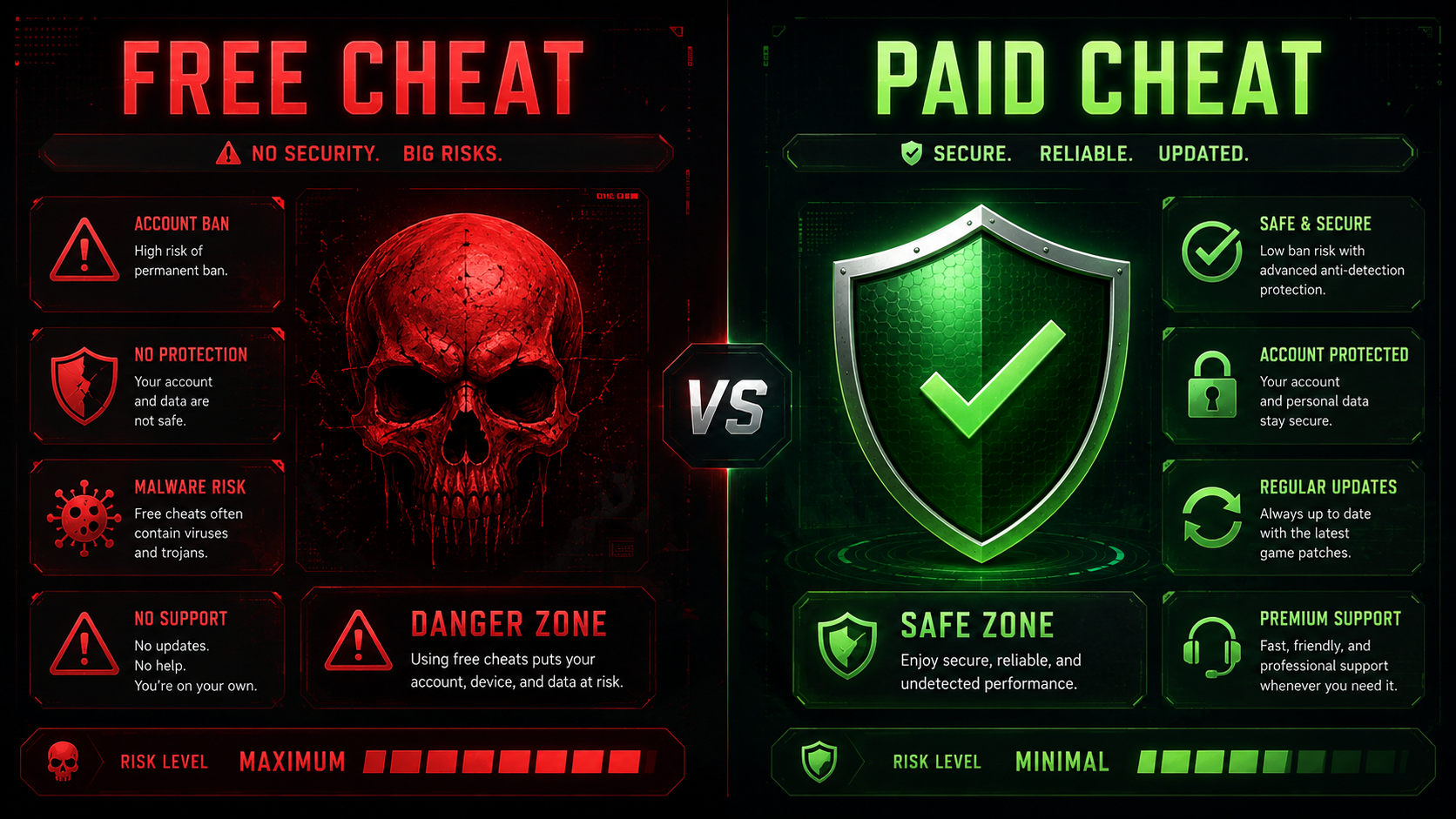
When you pay a reputable cheat provider, the money goes toward specific things that make the difference between playing safely for months and getting banned in an hour.
🔒 Unique Code Per User
Quality providers don’t ship the same binary to every customer. Each build is obfuscated differently, so one detection event doesn’t trigger a ban wave across all users.
⚡ Rapid Patch Response
Games patch constantly. After a major update, detection windows open. A good dev team has a new tested build deployed within hours — not days. That response time is what you’re paying for.
⚙️ Kernel-Level Engineering
Modern anti-cheats like Ricochet and Vanguard operate at the kernel level. Countering them requires software running at the same privilege level. That’s genuinely difficult engineering — not Discord copy-paste code.
🎧 Real Support
If a patch drops at 3am and your cheat goes offline, you need a team that responds fast. Free cheats have no meaningful support channel. Paid providers do — and that matters when something goes wrong.
Real Numbers: What “Free” Actually Costs When Things Go Wrong
Let’s put real numbers against this. Here’s what players typically lose when a free cheat goes wrong:
| What You Lose | Estimated Cost |
|---|---|
| Game account + DLC purchases | $60–$200+ |
| Steam inventory (if credentials stolen) | $0–$1,000+ |
| HWID ban recovery (new components or spoofer) | $30–$300+ |
| Banking/payment credentials if keylogged | Potentially unlimited |
| Hours spent rebuilding accounts and setup | 5–20+ hours |
On games like Black Ops 7 and ARC Raiders, a hardware ban doesn’t just lock you out of one title — it flags your entire PC. New accounts won’t help. If you need to recover from an HWID ban, our HWID Spoofer is built specifically for that situation. But you’re better off never being in that situation to begin with.
Compare all of that to $20–$30 a month for a provider that’s been running undetected for months, pushes updates within hours of patches, and includes real human support.
The math isn’t close.
How Anti-Cheat Systems Catch Free Cheats So Fast
Understanding why free cheats fail consistently comes down to how anti-cheat detection actually works. Games like Black Ops 7 and ARC Raiders run kernel-level anti-cheat drivers that load before the game itself. These drivers run several detection layers simultaneously:
Signature Scanning
Running processes and loaded drivers are checked against a database of known cheat signatures. Free cheats use publicly available code with signatures that are already catalogued. The match is instant.
Behavioral Analysis
Anti-cheat monitors for patterns that indicate cheat usage — perfect headshots at range, zero recoil on every spray, inhuman reaction times. Free cheats rarely include humanization layers that make behavior look natural.
Memory Integrity Checks
The anti-cheat verifies that game memory hasn’t been modified in flagged ways. Free cheats typically modify memory in obvious patterns that trip these checks immediately.
Report-Based Manual Review
Players getting spectated and reported triggers human review from anti-cheat teams. Free cheats don’t include guidance on settings that look human to spectators — so you get reported, reviewed, and banned.
Quality paid providers engineer around all four of these layers. Free cheats address none of them.
The “Cracked Paid Cheat” Trap
One variation worth calling out: cracked versions of paid software. These circulate constantly — someone takes a paid cheat, removes the license check, and distributes it free. Players assume they’re getting paid quality for nothing.
They’re not. Here’s what’s actually happening:
- The cracked version doesn’t receive updates, so it becomes detected within days of the real version receiving a patch
- The person who cracked it often injects their own payload — you’re running unknown code at kernel level on your PC
- Original providers frequently detect cracked copies and intentionally flag them to the game’s anti-cheat, making the crack a fast path to a hardware ban
- Without the license server, the cheat can’t authenticate properly and may behave erratically mid-session
There’s no safe version of a free cheat. There’s no shortcut around this.
What to Actually Look For in a Paid Provider
Since you’re going to pay for something, here’s how to evaluate whether it’s worth it:
Provider Evaluation Checklist
Detection history — How long has their software been running undetected? Any provider worth using publishes this clearly. Months of clean operation is the minimum benchmark.
Update speed — Do they push patches within hours of game updates? Check their public status page and community channels for evidence.
Trustpilot reviews — Not just the score but the content. Are customers discussing specific features that work? Are there patterns of consistent recent reviews?
Support response — Send a pre-sale question and see how fast you get a useful answer. What you get before purchase is exactly what you’ll get after.
Transparency — Does the site explain what the software actually does technically? Does it avoid promising things that are impossible?
The Bottom Line
Free cheats in 2026 fall into two categories: ones that ban you fast, and ones that ban you while also stealing your data. There is no third category.
The players who stay safe and keep playing month after month treat their cheat subscription the same way they treat their gaming hardware — as an investment in a reliable setup, not something to cut corners on.
A ban resets everything. A stolen account resets everything. A hardware ban costs real money to recover from. The $20 you saved on a free cheat was never actually free.
Ready to play with software you can actually trust?
SecureCheats has been operating since 2015 with over 380,000 players. Every product includes current detection status, full feature access, and 24/7 support.
Frequently Asked Questions
Are free game cheats safe to use?
No. Free cheats are almost always either immediately detected by anti-cheat systems, or they contain hidden malware like keyloggers and infostealers. In 2026, security researchers have documented thousands of cases where free cheat downloads contained credential-stealing malware disguised as gaming tools.
Why do free cheats get you banned so fast?
Free cheats use publicly known code signatures that anti-cheat systems like Ricochet, BattlEye, and EAC have already catalogued. The moment you inject a known signature, you’re flagged. Paid providers obfuscate each build uniquely and push updates within hours of every game patch.
What is the difference between free and paid cheats?
Paid cheats are actively maintained by development teams who reverse-engineer anti-cheat updates, rewrite code signatures, and push patches within hours. Free cheats are static — nobody is maintaining them, so they get detected fast and are never updated.
Can free cheats steal my password?
Yes. Cybersecurity researchers have repeatedly documented free cheat files containing Lumma Stealer, RATs (remote access trojans), and Discord token grabbers. These run silently in the background while you play, harvesting saved passwords, browser cookies, and banking credentials.
How much do paid cheats cost?
Quality paid cheats typically range from $15 to $30 per month depending on the game and features. SecureCheats offers subscription pricing with full feature access, 24/7 support, and rapid post-patch updates.
Author & Review
Written by: Raziel — Lead Engineer, 15+ years in reverse engineering & anti-cheat research
Reviewed by: SC Quality Assurance — Former anti-cheat analyst
Last updated: May 2026
The SecureCheats team includes engineers, reverse-engineers, and security analysts with 40+ combined years of experience. We test every claim on this page against live anti-cheat systems before publishing.
